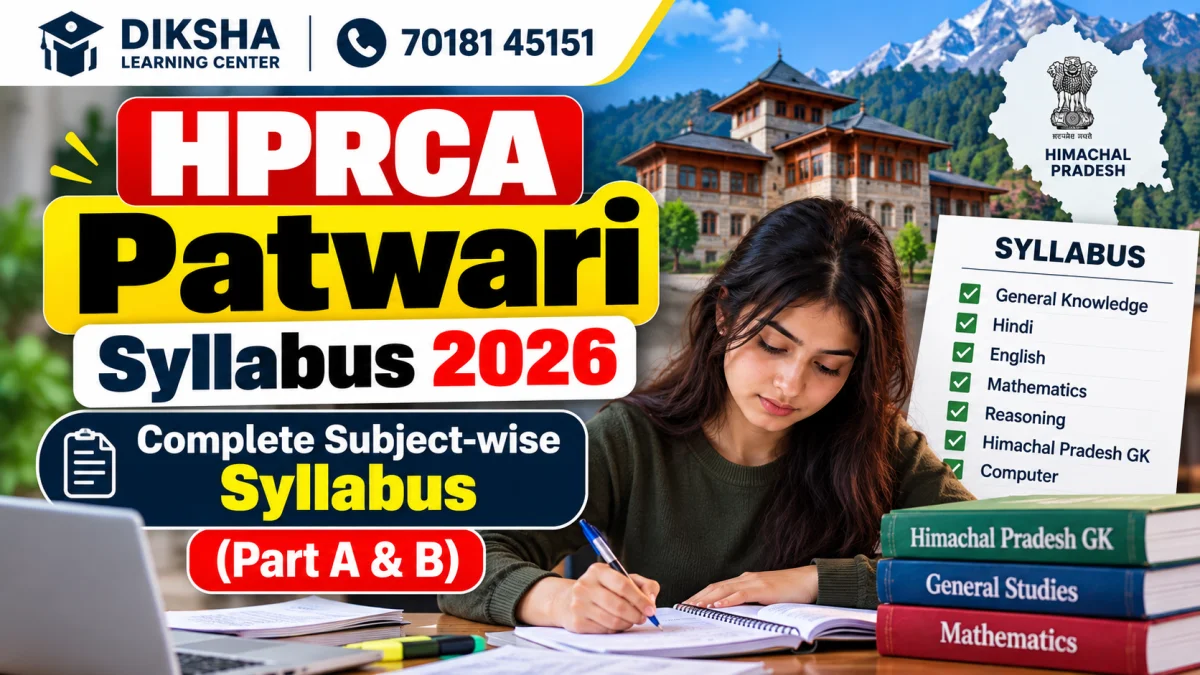
HPRCA Patwari Syllabus 2026: Complete Subject-wise Syllabus (Part A & B)
The Himachal Pradesh Rajya Chayan Aayog (HPRCA) has released the syllabus for the Patwari recruitment exam, and candidates preparing for this post need a clear subject-wise breakdown before they start revision. The syllabus is divided into two parts: Part A, which covers topics up to the 10+2 level across Social Science, Mathematics, Science, English, Hindi, and Computers, and Part B, which covers General Awareness. Below is the complete HPRCA Patwari syllabus 2026, organized subject by subject so you can plan your preparation systematically.
Since Part A draws directly from the school-level curriculum, candidates who build their notes around the NCERT structure for Classes 9 to 12 will find most of this syllabus familiar. The History and Political Science sections are particularly detailed, covering everything from ancient Indian civilization to modern constitutional development, so these deserve focused attention. Mathematics and Science sections follow a fairly standard board-exam pattern, while Part B's General Awareness section will require continuous revision of current affairs and Himachal Pradesh-specific general knowledge right up to the exam date.
Part A: History
| Section | Topics |
|---|---|
| Ancient Indian History | Hunting-gathering societies, stone tools, Palaeolithic/Mesolithic/Neolithic Age, Copper/Bronze/Iron Age, Indus Valley Civilization (sites, urban planning, trade, crafts, social stratification), Pre-Vedic and Vedic culture, religious movements, Mauryan Empire, Shakas, Kushanas, Satavahanas, Sangam Age (Cholas, Pandyas, Cheras), Gupta Age, Post-Gupta Age (Harshavardhana) |
| Medieval Indian History | Turkish invasions (Muhammad bin Qasim, Mahmud of Ghazni, Muhammad Ghori), Delhi Sultanate (Mamluk, Khilji, Tughlaq, Sayyad, Lodi dynasties), Sufi movement, Chishti order, Bhakti Movement (Shankara, Ramanujacharya, Kabir, Guru Nanak, Mirabai, Chaitanya and others), Mughal Empire, Maratha Empire, Rise of Sikh Empire |
| Modern Indian History | Arrival of European companies, Governor Generals of Bengal, Viceroys of India, Revolt of 1857, social and religious reform movements, National Freedom Movement (INC, Partition of Bengal, Swadeshi and Swaraj, Khilafat Movement, Non-Cooperation Movement, Simon Commission, Civil Disobedience Movement, Quit India Movement, Cabinet Mission, Mountbatten Plan), Constitutional Development (Regulating Act 1773 to Indian Independence Act 1947) |
| European History | French Revolution, Industrial Revolution, Unification of Germany and Italy, First World War, League of Nations, Russian Revolution and Socialism, Fascism in Italy, Nazism in Germany, Second World War, United Nations Organization |
Part A: Geography
India's size, location and neighbours; physical features (Himalayas, northern plains, peninsular plateau, desert, coastal plains, islands); drainage systems (Himalayan and Peninsular rivers); climate and monsoon; natural vegetation and wildlife; population distribution and growth; resources and development (forest, water, minerals, energy); multipurpose river projects; Universe and Solar System; rocks, volcanoes, earthquakes, landforms; agriculture, cropping patterns, types of farming; minerals and power sources; transport and communication; rainwater harvesting; land use and land degradation
Part A: Economics
Concept of development and its indicators; sectors of the Indian economy (primary, secondary, tertiary; organized and unorganized; public and private); Money and Credit (banking, formal and informal credit); Globalization and the Indian Economy (foreign trade, WTO, impact of globalization); Consumer Rights; food security; poverty and related challenges
Part A: Political Science
What is Democracy, Constitutional Design, Electoral Politics, Working of Institutions (Parliament, Executive, Judiciary), Democratic Rights; Constituent Assembly, Preamble, Fundamental Rights and Duties, Directive Principles, Parliament and its two houses, President, Vice-President, Governor, State Legislative Assemblies, Judiciary at National/State/local level, Centre-State relations, Emergency provisions, Constitutional Amendments since 1951, Budget, Election Commission, Panchayats and Municipalities, Finance Commission, CAG, Attorney General, Anti-Defection Law, CBI; Power Sharing, Federalism, Gender/Religion/Caste in politics, Political Parties, Outcomes of Democracy
Part A: Mathematics
| Topic | Details |
|---|---|
| Number Systems | Place/face value, Indian and International numeration, natural/whole numbers, integers, prime and composite numbers, divisibility tests, HCF and LCM, rational and irrational numbers, laws of exponents, squares, cubes, square and cube roots |
| Algebra | Expressions, identities, factorization, polynomials (degree, zeroes, Remainder and Factor Theorems), linear equations in one and two variables, graphical solutions, quadratic equations, Arithmetic Progression, ratio and proportion |
| Geometry | Points, lines, angles; triangles (congruence, similarity, Pythagoras theorem); quadrilaterals and polygons; circles (chords, tangents, cyclic quadrilaterals); geometric constructions; coordinate geometry (distance and section formula) |
| Mensuration | Area and perimeter of plane figures, Heron's formula, surface areas and volumes of cube, cuboid, cylinder, cone, sphere and hemisphere, combined solids |
| Trigonometry | Trigonometric ratios and identities, standard angle values, heights and distances (angle of elevation/depression) |
| Statistics & Probability | Data handling, frequency distribution, bar graphs, histograms, mean/median/mode, cumulative frequency, experimental and theoretical probability |
| Other Topics | Work and Time, Exponents of Power, Direct and Inverse Proportion, Time and Distance |
Part A: Science
Components of food; materials and their properties; separation of substances; plants (herbs, shrubs, trees); body movements and skeleton; habitats and adaptation; motion and measurement; light, shadows and reflection; electricity and circuits; magnets; air and atmosphere; nutrition in plants and animals; heat; acids, bases and salts; physical and chemical changes; respiration; reproduction in plants and animals; motion and time; electric current and its effects; light (reflection, mirrors, lenses); forests and water resources; crop production; microorganisms; coal and petroleum; combustion and flame; conservation of plants and animals; adolescence; force and pressure; friction; sound; chemical effects of electric current; natural phenomena (lightning, earthquakes); matter and its states; atoms and molecules; structure of the atom; cell structure and tissues; improvement in food resources; motion, force and laws of motion; gravitation; work and energy; sound; chemical reactions and equations; acids, bases and salts; metals and non-metals; carbon and its compounds; life processes; control and coordination; reproduction in organisms; heredity and evolution; light - reflection and refraction; the human eye; electricity; magnetic effects of electric current; our environment
Part A: English, Hindi & Computers/IT
| Subject | Topics |
|---|---|
| English | Reading comprehension, word power, sentence structure, subject and predicate, articles, number, gender, punctuation, parts of speech, finite and non-finite verbs, error correction, sentence rearrangement, vocabulary, antonyms and synonyms, tenses, subject-verb agreement, idioms, modals, active and passive voice, direct and indirect narration, phrases and clauses, one word substitution, sentence transformation |
| Hindi | Hindi grammar and script, varn vichar, shabd vichar (tatsam, tadbhav, deshaj, videshi), vikari and avikari shabd, sandhi, samas, upsarg, pratyay, vakya vichar, paryayvachi and vilomarthi shabd, viram chinh, shuddhikaran, muhavare and lokoktiyan, alankar |
| Computers / IT | Computer organization, fundamentals and components of computer, operating system, troubleshooting and utilities, computer networking, internet and its terminology, cyber threats and cyber security, office automation tools (word processing, spreadsheet, presentation), e-Governance, MIS |
Part B: General Awareness
General Knowledge including General Knowledge of Himachal Pradesh, Current Affairs, Everyday Science, Logical Reasoning, Hindi (Matric standard), English (Matric standard)
Final Word
With a syllabus this broad, the most efficient approach is to build your preparation around the NCERT textbooks for Classes 9 to 12, since almost all of Part A is drawn directly from that curriculum. Prioritize History, Political Science and Geography early, since they carry the most ground to cover, while keeping daily practice going for Mathematics and reasoning so your speed stays sharp closer to the exam. For Part B, treat Himachal Pradesh-specific General Knowledge and Current Affairs as a running revision subject rather than something to start late - a little consistent reading each day will make a noticeable difference by the time the exam date arrives.